
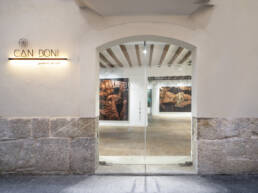
New Can Boni space in Palma
Palma de Mallorca, a city teeming with history, has always been a canvas for the confluence of past and present. And in the heart of this cultural tapestry lies the Can Boni Gallery. In the year 2023, this art institution took a momentous step forward by expanding its premises, redefining the very essence of art in Palma.
New Can Boni space: A Fusion of History and Modernity
Can Boni Gallery’s expansion is not merely an architectural makeover; it’s a fascinating blend of medieval origins and contemporary vision. The result is a space that not only reveres its historical roots but also paves the way for innovative art experiences.
This expansion is set to position Can Boni Gallery as a modern hub within Palma’s thriving art scene. It offers an enhanced capacity to host remarkable exhibitions and further strengthen its ties to the city’s cultural fabric.
The Medieval Alhóndiga Reimagined
The story of Can Boni Gallery’s transformation begins with its medieval origins as an “alfóndenc” or alhóndiga—a term steeped in history. In essence, these were buildings where foreign merchants converged for trade, featuring inns, warehouses, and shops. The etymology of “alfóndec” traces back to the Arabic word “al-fundaq,” meaning “inn.”
Even amidst centuries of transformations, remnants of the alhóndiga’s structure still grace the gallery’s courtyard. Two superimposed columns stand as a testament to its history, reminding visitors of its former life.
These alhóndec structures typically featured rectangular inner courtyards, with arches or pillars on the ground and upper floors, creating open porticoes. This design facilitated the movement of goods, both on the ground floor and upper levels, using ropes and pulleys.
A Peek into the 18th and 19th Centuries
According to historian Aina Pascual, in the 18th century, the building was the residence or “posada” of a landowning family from Binissalem. It was a substantial house with various chambers, a patio, an attic, and even a shop.
The architectural charm of the 18th century still graces the gallery’s façade, with well-preserved balconies and ogee arched windows on the first floor. These architectural elements might date back to the 15th or 16th century, further underscoring the historical layers within the structure.
In the 19th century, the building’s narrative shifts to house a noodle factory owned by the same Binissalem family. The surviving “trull” or mill used for grinding pasta stands as a precious ethnological relic, a testament to the location’s diverse history.
Later, in the late 19th century, the property found itself under the ownership of the Palou de Comasema family, prominent landowners in Mallorca. Subsequently, in 1912, it became the possession of Mrs. Josefa Vives i Cardell, whose descendants held onto it until 1987.
The Visionary Revival by Nieves Lafarga Estop
The late 20th century saw the house in a state of disrepair until it was acquired by the visionary Nieves Lafarga Estop. She initiated a comprehensive rehabilitation that gave the building a new lease on life. Though not entirely completed, this marked the start of the building’s modern transformation.
Nieves Lafarga Estop divided the interior into three houses and a commercial space on the ground floor, which was later reformed for the Ferran Cano Gallery at the turn of the 21st century. This move breathed new life into a space that was once on the brink of oblivion.
Uncovering Palma’s Historical Threads
As we delve into the past of the space, we unearth the rich history of Palma itself. The building’s origins as an alhóndiga provide a unique perspective on the city’s role as a trade hub. It was a place where merchants from diverse backgrounds converged, fostering a spirit of exchange and collaboration.
The 18th and 19th-century chapters tell the story of a family’s residence, a noodle factory, and the architectural evolution of the gallery. These layers add depth and character to the space, making it a canvas for both history and art.
Nieves Lafarga Estop’s transformative vision demonstrates the enduring allure of Palma’s historical buildings. It serves as a testament to the gallery’s commitment to preserving the past while embracing the future.
Today, Can Boni Gallery’s new space stands as a living testament to Palma’s rich history and thriving art scene. Its expansion not only provides more space for exhibitions but also offers visitors a captivating journey through time. As you step through its doors, you embark on a voyage that spans centuries, where history and modernity harmonize in the most exquisite way.
In Palma de Mallorca, Can Boni isn’t just a gallery; it’s a story waiting to be explored, a canvas waiting to be painted anew. It’s a place where the past and the present collide, creating a tapestry of art and history that continues to evolve.